|
HOW TO PROTECT YOURSELF FROM AN ACL TEAR
DR.
JIM FORBES
In the United States there are over 250
000 anterior cruciate ligament (ACL) tears a year
and the most common sports for this injury are
basketball, football, and soccer. It is also worth
noting that women are 5 times more likely to have
an ACL tear than men. The Anterior Cruciate
Ligament (ACL) is a ligament in our knee that
resists forward and rotational movements of our shin
bone (tibia) on our thigh bone (femur). An ACL
tear is devastating to an athlete as it can sideline
an athlete for up to 6 months by the time surgery
and rehab is completed. For these reasons, it is
obvious that we should train our legs to prevent
this from happening. Below, is a step wise approach
to an “ACL Tear Prevention Program” that trains the
strength, endurance, and quickness of the muscles
which control the hip and leg. These muscles must
be able to maintain a strong leg through jumping,
landing, cutting, and pivoting activities in which
ACL tears commonly occur. REMEMBER these exercises
are just examples. To form a program based on your
own personal needs you should contact a health
professional who is fluent in preventative exercise.
Goals
-
Avoid the harmful “valgus
collapse” of the knee
-
Alter landing and acceleration
patterns
-
Remove strength deficiencies of
non dominant leg
-
Restore a normal hamstring and
quadriceps strength
-
Make hip and knee muscles firing
quicker
-
Make hip and knee muscles
stronger
-
Increase hip and knee muscle
endurance.
1)
Avoid the harmful “valgus collapse” of the knee
It is interesting to note that most
ACL tears occur without any contact from another
person.  This happens due to an inability to
maintain proper knee position during landing, from a
sharp cutting maneuver, or a jump. Most commonly
the knee tends to fold inward into what is termed
“valgus collapse”. This causes excessive stress
on the ACL and can lead to an eventual tear of the
ACL. This can occur as a result of muscles at the
hip and knee not being strong enough to keep the leg
straight or muscles not firing quick enough to
maintain a straight leg. These issues are more
commonly seen in females which is why ACL tears
are more common with women. This happens due to an inability to
maintain proper knee position during landing, from a
sharp cutting maneuver, or a jump. Most commonly
the knee tends to fold inward into what is termed
“valgus collapse”. This causes excessive stress
on the ACL and can lead to an eventual tear of the
ACL. This can occur as a result of muscles at the
hip and knee not being strong enough to keep the leg
straight or muscles not firing quick enough to
maintain a straight leg. These issues are more
commonly seen in females which is why ACL tears
are more common with women.
This program was developed to strengthen
muscles of the hip and knee in order to prevent
“valgus collapse” of the knee and to increase
performance of the hip. This program can be
implemented as a preventative measure to prevent an
ACL tear and to make your legs stronger and more
efficient for activity.
2)
Alter accelerating position of knees
-
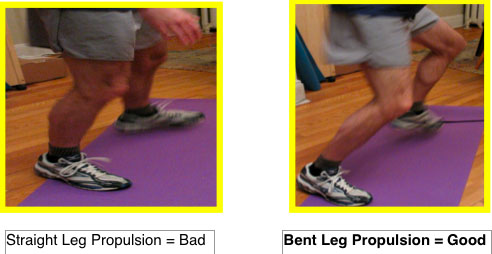
When
accelerating from a standing still position to
pursue or run away from a defender
it is necessary that you do so with a knee that
is flexed. This will ensure that there is
decreased stress on the ACL.
3)
Alter landing patterns
-
This is
the most important predictor of an ACL tear that
occurs with no contact. When a player lands and
then falls due to an ACL tear, this is the reason it
happens. When landing you must ensure that the
knees are in line with the hips and they
are not turned in to what we previously called
“valgus collapse”. This holds true for both single
and double leg landing.
-
As well,
it is important to land closer to the ground with
more knee flexion as this will take more stress off
of the ACL.

4)
Normalize strength of the non dominant leg.
-
It is best
not to favour one leg in any workout or practice
situation as it is most commonly the ACL of the non
dominant leg that tears. When working out it is
best to perform 3-4 more reps with the non
dominant leg.
5)
Normalize the hamstring to quadriceps strength ratio
-
Your
hamstrings are the muscles on the back of your thigh
and your quadriceps are the muscles on the front of
your thigh. The hamstrings flex the knee and the
quadriceps extend the knee. The goal of this
program is to strengthen the hamstrings in a more
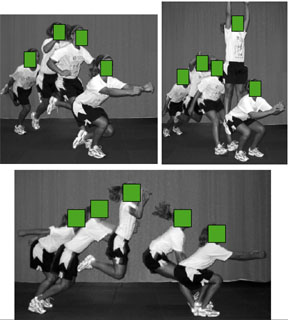
favourable position over the quadriceps. Thus, all
leg exercises should be performed in a deep squat
position when the knee is past a 45* angle as shown
below.
6)
Make hip and knee muscles fire quicker
-
When doing
dynamic activities in sports we rely on the quick
speed of contraction of our muscles to move our body
and keep our joints in safe positions while
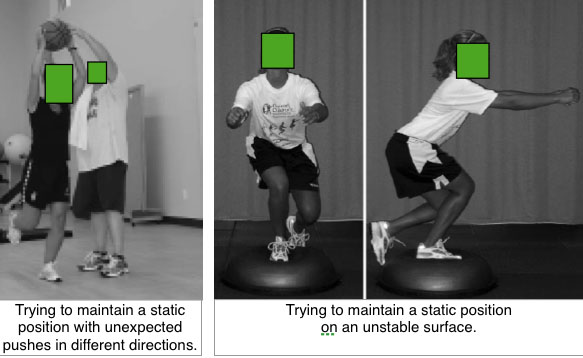
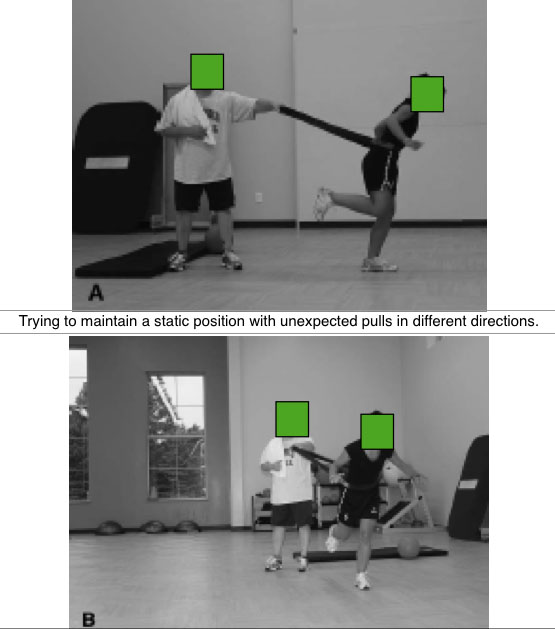
performing athletic movements. One way we can do
this is to exercise on unstable surfaces or do
exercises while withstanding outside perturbations.
7)
Make hip and knee muscles stronger
-
There are
many different factors and exercises that go into a
leg strength and conditioning program. It is all
dependent on your sport and its demands, as the
requirements are different. However, some muscles
that are often overlooked in a leg strength program
are the gluteus minimus and medius, and gluteus
maximus.
-
Here are
some exercises that should be added to every leg
strengthening program.

8)
Increase hip and knee muscle endurance
-
It has
been proven that when you are tired (late in a game)
the likelihood of having “valgus collapse” increases
and when it does occur the severity of the collapse
is worse. For this reason, it is wise to train the
endurance of the muscles that prevent valgus
collapse so we can ensure safe play later in the
game.
-
This is
done by increasing the repetitions of each exercise
to a minimum of 12 for at least 3 sets.
-
The amount
of resistance and the time which each exercise must
be performed is determined by the demands of the
athlete’s sport.
In conclusion, if you prepare your body
for the stresses of your sport you can avoid a
devastating injury which could sideline you for the
season while making make your legs stronger,
quicker, and more resilient to fatigue which will
increase your performance. As mentioned before,
consult your local health practitioner who is
familiar with preventative and performance based
exercise as to which exercises and how much exercise
is safe for you to perform.
Dr. Forbes is a
chiropractor in Sarnia who is devoted to providing
honest, comprehensive and effective care with
special emphasis on sports injuries and preventative
rehabilitation. If you would like Dr. Forbes to do a
complementary group/team presentation on a topic of your
choice please contact him at:
Dr. Jim Forbes
Chiropractor, ART & Medical Acupuncture Provider
Hare Chiropractic and Natural Health Centre
1389 Colborne Rd. Sarnia
519 332 4222
DrJimForbes@Gmail.com
Twitter: @DrJimForbes
Follow Sarniasports on twitter
@sarniasports.
Get up to the minute news, and live scores
as they happen from local events. |

